
CRO Marketing: Conversion Rate Optimisation
CRO Marketing or Conversion Rate Optimisation is an essential strategy in the digital marketing which allows to increase the conversion of a website, without the need to increase traffic. In an environment where digital competition is increasingly fierce, it is crucial to convert them into active customers or users.
"Conversion rate optimisation is not a sprint, but an ongoing commitment to the user experience". Juan Carlos Meneses.- SEO Consultant Marketzilla SEO Agency
CRO is based on the analysis of user behaviour to identify barriers to conversion. It also optimises every touch point within the SALES FUNNEL.
From improving the user experience to implementing A/B testing and persuasion strategies. CRO allows you to maximise the performance of each visit, achieving higher revenue and better results without the need to increase spending on traffic acquisition.

In this article, we will explain what is CRO, how does it work and what are its benefits for your business?. But what does it really mean CRO and why it is key to maximising digital performance? In this article, we will explain what is CRO, how does it work and what are its benefits for your business.
What is CRO?
The CRO (Conversion Rate Optimisation) is a discipline of the digital marketing focused on maximising the percentage of visitors who complete a key action on a website. Rather than simply attracting more traffic, CRO seeks to improve the effectiveness of each visit by analysing user behaviour. Also, optimising critical elements of the page.

Through the CROBy using the conversion funnel, companies can detect friction points within the conversion funnel. Apply strategies that incentivise the user to complete the desired action, whether it is a purchase, subscription or content download. This methodology increases the profitability of the website, improves the user experience, ensuring that each interaction with the website is as efficient and satisfying as possible.
The CRO is a set of techniques and strategies designed to increase the percentage of visitors who take a desired action on a website. These actions may include:
- Make a purchase.
- Complete a contact form.
- Subscribe to a newsletter.
- Download a digital resource.
The CRO does not seek to attract more visitors, but rather to maximise the value of those who already arrive. to the site, optimising key elements such as design, usability and calls to action (CTAs).
Would you like one of our SEO Analysts to audit your website?
What is a company's CRO?
When we talk about a "CRO of a companyWe refer to the team or specialist dedicated to analysing, devising, testing and refining key elements of the website, the user experience and the conversion funnel. Their goal is to increase the likelihood that visitors will take valuable actions for the business. Be it a purchase or any other conversion defined by the brand.
What is the role of the CRO?
The CRO (Conversion Rate Optimisation) serves the function of maximising efficiency of every touch point between the user and the company, focusing on improving the conversion rate on a website or application.
In other words, it aims to get a higher percentage of visitors to perform the desired action (purchase, subscription, registration, download, etc.) without the need to increase the volume of traffic. This is achieved by continuously analysing and optimising elements such as page design, sales funnel structure, content relevance and usability, so that each interaction generates as many positive results as possible.

What is the purpose of CRO Marketing?
The aim of the CRO Marketing is to maximise the percentage of visitors who take a key action on a website, such as completing a purchase, registering or subscribing to a service. It's not just about increasing conversions, it's about optimise the user experience to reduce friction and make the conversion process more intuitive and efficient.
Through CRO, companies can make the most of their existing traffic without the need to increase investment in advertising or SEO. This is achieved by A/B testing, loading speed improvements, call to action (CTA) optimisation and UX/UI design adjustments.. In short, CRO allows each visit to have more value, helping to improve profitability and business growth.
The main purpose of the CRO is to convert visitors into potential customers or buyersoptimising every step of the conversion funnel. To achieve this, it focuses on improving:
🔹 User experience (UX/UI)An intuitive and easy-to-navigate website improves conversion.
🔹 Loading times: A slow website generates abandonment and reduces the conversion rate.
🔹 CTAs and forms: Optimised designs to capture the user's attention and facilitate the user's action.
🔹 Trust and credibilityTestimonials, security seals and guarantees can make the difference.

Why is CRO key to your digital marketing strategies?
CRO is a fundamental part of digital marketing, as it allows for making the most of existing traffic. It also increases conversion without the need to invest more in advertising. Its main benefits include:
Increased profitability: More conversions with the same traffic reduces costs and increases revenue.
Better user experience: It facilitates navigation and avoids friction in the purchasing process.
Data-driven decisions: A/B testing and behavioural analysis allow you to optimise strategies.
Competitive advantage: An optimised site stands out from the competition.
Example: If an online shop has 10,000 monthly visits and a conversion rate of 1%, it will achieve 100 sales. If through CRO it improves its conversion rate to 2%, double its sales no need to attract more traffic.

Main CRO strategies
User behaviour analysis
To improve conversion, you must first understand how users interact with your website. Tools such as:
- Google Analytics: Allows you to analyse traffic and detect pages with high bounce rates.
- Hotjar o Crazy EggHeat maps and session recordings show in which parts of the site users interact the most or abandon.
- Google Tag Manager: Helps track key events and conversions.
A/B Testing
It consists of comparing two versions of a page to determine which one generates better conversions.
Examples of A/B testing:
CTA buttons: Test different colours, texts and locations.
Forms: Reducing the number of fields can improve conversion.
Images and design: Use different presentations to assess which has the greatest impact.
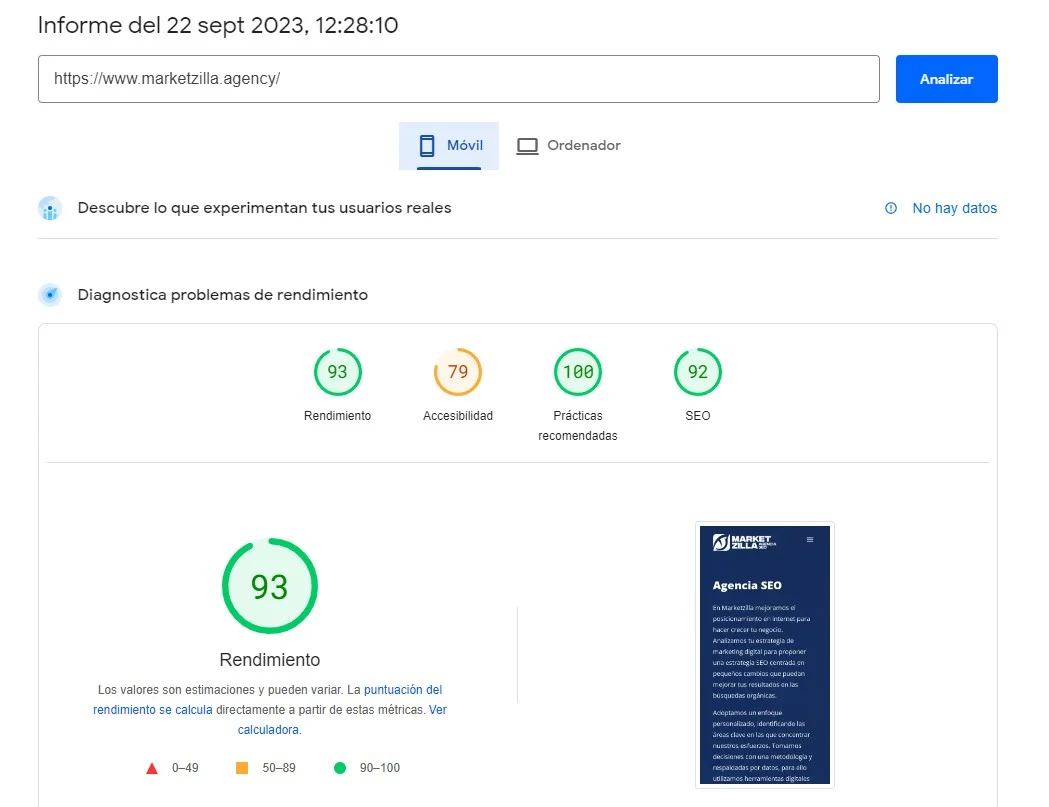
Optimisation of loading speed
A slow site is a conversion killer. Actions to improve speed:
Optimisation of images and videos.
Use of cache and file compression.
Implementation of CDN for global fast loading.
Design and user experience (UX/UI)
An intuitive and attractive design builds confidence and facilitates navigation.
Key aspects:
- Responsive designAdapted to all devices (prioritising mobile if traffic is higher in this segment).
- Fewer clicks, more conversionSimplify the purchase or registration process.
- Visible and attractive CTAsUse action verbs and eye-catching colours.
Persuasive copywriting and social proof
Good copy can make a difference in conversion.
Clear and direct messages.
Generate urgency with limited offers.
Show testimonials, reviews and guarantees.
Differences between SEO and CRO
It is common to confuse the SEO positioning (Search Engine Optimisation) with the CROalthough the two have different approaches:
| Feature | SEO | CRO |
|---|---|---|
| Target | Attracting traffic | Converting traffic into customers |
| Approach | Search Engine Optimisation | Optimising the user experience |
| Methods | Keywords, backlinks, optimised content, technical seo | A/B testing, form improvement, UX/UI optimisation |
Relationship between SEO and CROA website can have a lot of traffic thanks to SEO, but if it is not optimised for conversion, it will not generate results. The SEO attracts visitors, CRO converts them into customers.

Case study: CRO application in eCommerce
An online clothing shop noticed that, although they had a lot of visitors, their conversion rate was low. They applied the following CRO strategies:
Identification of the problem: Through Google Analytics and Hotjar, they detected that users abandon the cart before completing the purchase.
Solution:
They simplified the payment process, reducing the number of forms.
Implemented A/B testing on buy buttons to improve their effectiveness.
They activated pop-ups with discounts to retain undecided users.
Improved the loading speed to avoid slower loading times.
Result: 25% increase in conversion rate and reduction in the cost of customer acquisition.
Why apply CRO in your business?
Implement CRO Marketing strategies not only improves conversions, but also maximises profitability without increasing traffic. Apply techniques such as A/B testing, user experience optimisation and persuasive copywriting can make a difference to your business results.
- Increased conversions without more traffic.
- Better user experience.
- Higher return on investment (ROI).
- Differentiation from the competition.
If you are looking to optimise the conversion of your website and improve the performance of your digital strategy, Applying CRO is the next step to scale your business!