
Learn how to measure SEO success: The 12 essential SEO KPIs
How to measure the success of establishing SEO Kpis in your action plan
The SEO KPIs as well as commercial objectives must go hand in hand. However, as SEO Consultant, In most cases, I come across online businesses without defined objectives and therefore without indicators because they do not know what to measure. Therefore, without SEO objectives, we cannot establish KPIs (Key Performance Indicators) in order to measure the performance of the SEO campaign we implement. SEO KPIs are metrics that help companies measure the success of a particular initiative, in this case, the launch and performance of a new website or an already published one.
There are several tools available to meet this objective and to know if we are on the right track. In particular, we we recommend Semrush which is the best one and the one we work with in our Marketzilla SEO Agency.
The SEO has multiple variables and aspects, therefore, it is essential to establish clear KPIs that indicate whether we are on track to meet the proposed objectives.
In this guide we will show you the most important KPIs to evaluate your SEO strategy:
We invite you to take a free trial of the best SEO tool of the world, Semrush, find out more below.

12 SEO KPIS for success
Through these metrics you will be able to keep track of how well your SEO actions. We use in Marketzilla indistinctly these parameters to measure our SEO strategy with our clients.
Misleading SEO KPIs:
It is important when establishing the SEO KPIs We need to make sure that we are selecting some or all of the right ones from the list. There are certain KPIs that can be misleading, skew our measurements and mislead our decision making. Some of these are:
Total Number of Visits
- While traffic may seem like a good indicator, not all traffic is valuable. What really matters is qualified traffic, i.e. users who are potential customers or are interested in your content. It is also important to know the intentionality rates of the keywords you rank for.
Number of Page Views
- While it might suggest that users are interacting with your site, this KPI tells you nothing about the quality of the interaction. A user could be browsing multiple pages and still not find what they are looking for.
Number of followers on social networks
- Although great for ego, having a high number of followers on social media does not guarantee SEO success or a better conversion rate. This KPI is more relevant for social media marketing strategies than for SEO.
Number of Downloads or Newsletter Subscriptions
- These can be good indicators of engagement or interest, but they don't necessarily translate into better SEO performance. You could have lots of subscribers but low organic traffic, which is a problem.
Total Time on Site
- A longer time might suggest that users find your content interesting, but it could also mean that they have difficulty finding what they need, which is not a good indicator of an optimised user experience.
ROI (Return of Investment)
Every company that makes an investment expects a return. Therefore, tracking the ROI of your SEO tactics is essential to be able to measure in euros that more money has come in than you have invested in these actions in the medium term. Normally, ROI is calculated over a period of 6 to 12 months.
Profitability can be calculated by considering what you have invested in SEO in relation to the revenue you have earned through this channel.
2. Conversions (sales and leads)
Of course ROI should not be your only indicator to measure your success. Measuring organic conversions and following them, should be your next step. Note that conversions can be in the form of sales (if it's an ecommerce) or in the form of leads (if it's a form, a call or a file download). Increasing organic conversions is directly related to SEO efforts.
Before you start with your SEO strategy, you should have a reference on what the current situation is. This avoids confusion as to whether the increase was a previous trend or a product of your efforts.

A good starting point can be to take the previous quarter as a reference before starting. We then contrast this with the quarter developed through the SEO strategy.
Via Google Analytics 4 we can track conversions that have been previously set up on the website. You may need to set up some specific ones that you are interested in measuring.
Organic visibility
Organic visibility is one of the most important KPIs relevant. In order to measure it properly you can use Google Search Console measuring impressions. Impressions are the number of times your URL result is displayed in the SERPs in response to a keyword and is viewed by the user.

Impressions do not reflect clicks. If your SEO is working and you are ranking on the first page for keywords, impressions will increase. If clicks do not increase, it will affect the CTR. But that's another story, as we will have to review the title and meta description that are responsible for favouring that metric.
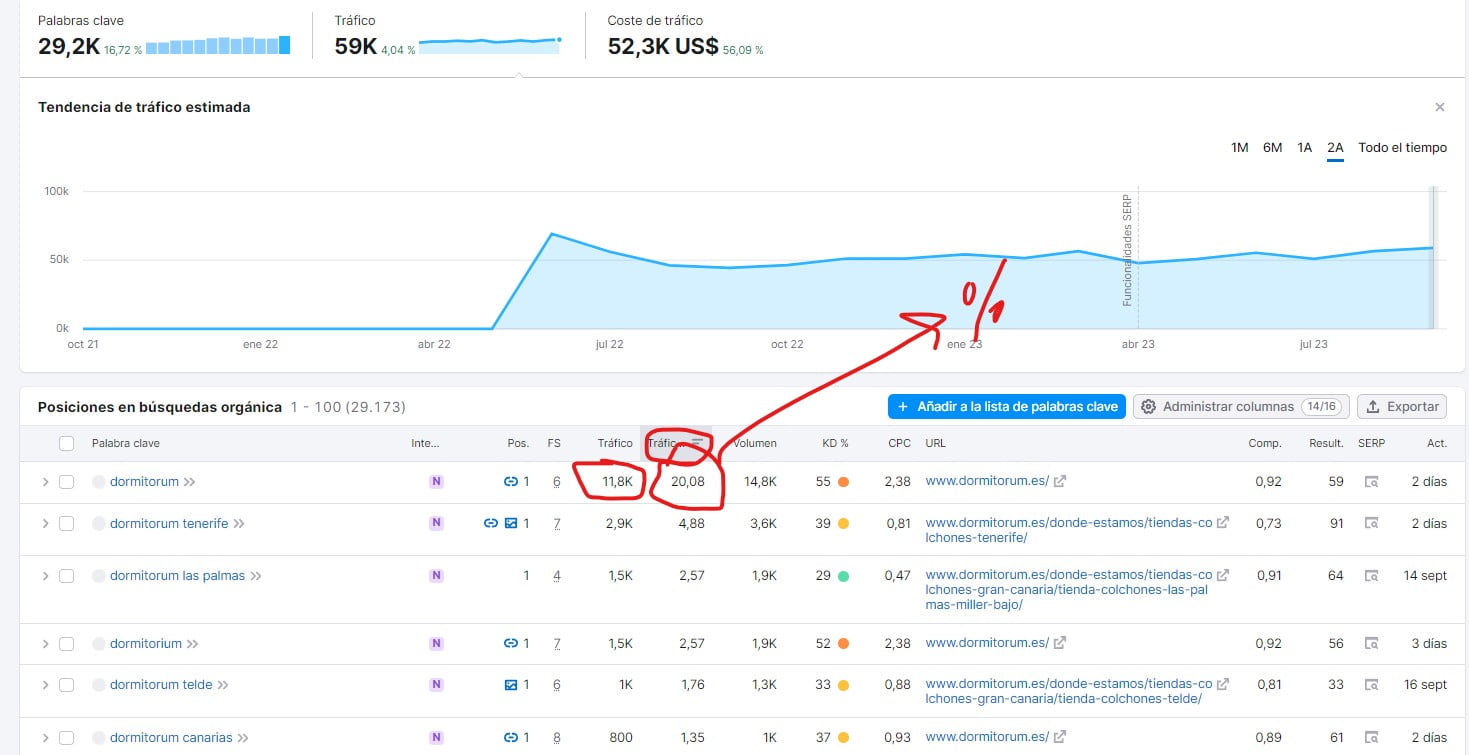
Another metric that will help us to understand whether our organic visibility is improving is by studying the growth trends of organic keywords. We can do this with the Semrush keyword research tool.

4. Number of organic sessions
When we manage to increase the organic impressions, verified through Google Search Console, the organic sessions should increase proportionally. And you may ask yourself, but what is organic sessions (coming from organic searches), it is simply “traffic” to your website.
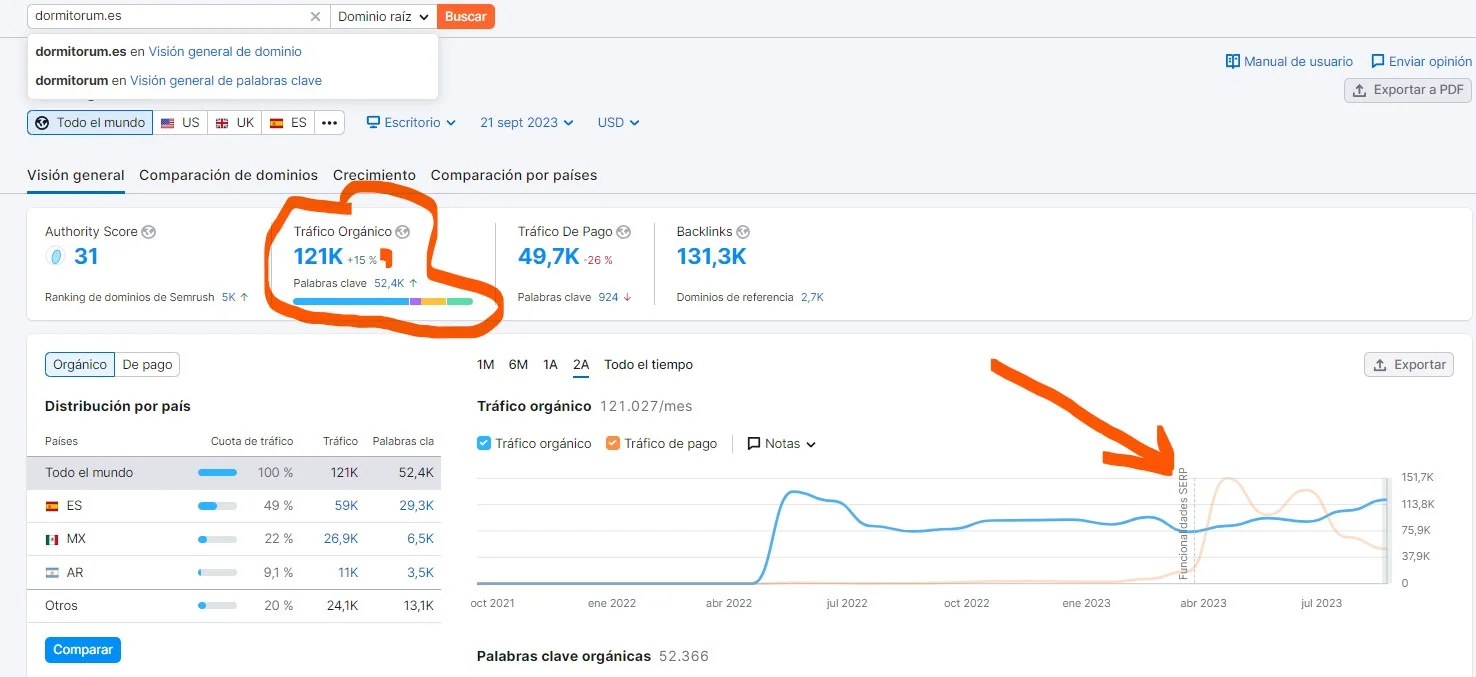
With Google Analytics 4 we can easily calculate organic sessions. However, to find out the SEO KPIs It is best to use Google Search Console to see clicks on non-branded search keywords. Branded searches should be removed as they skew the results.
If you have a Semrush account, you can easily do this using filters:
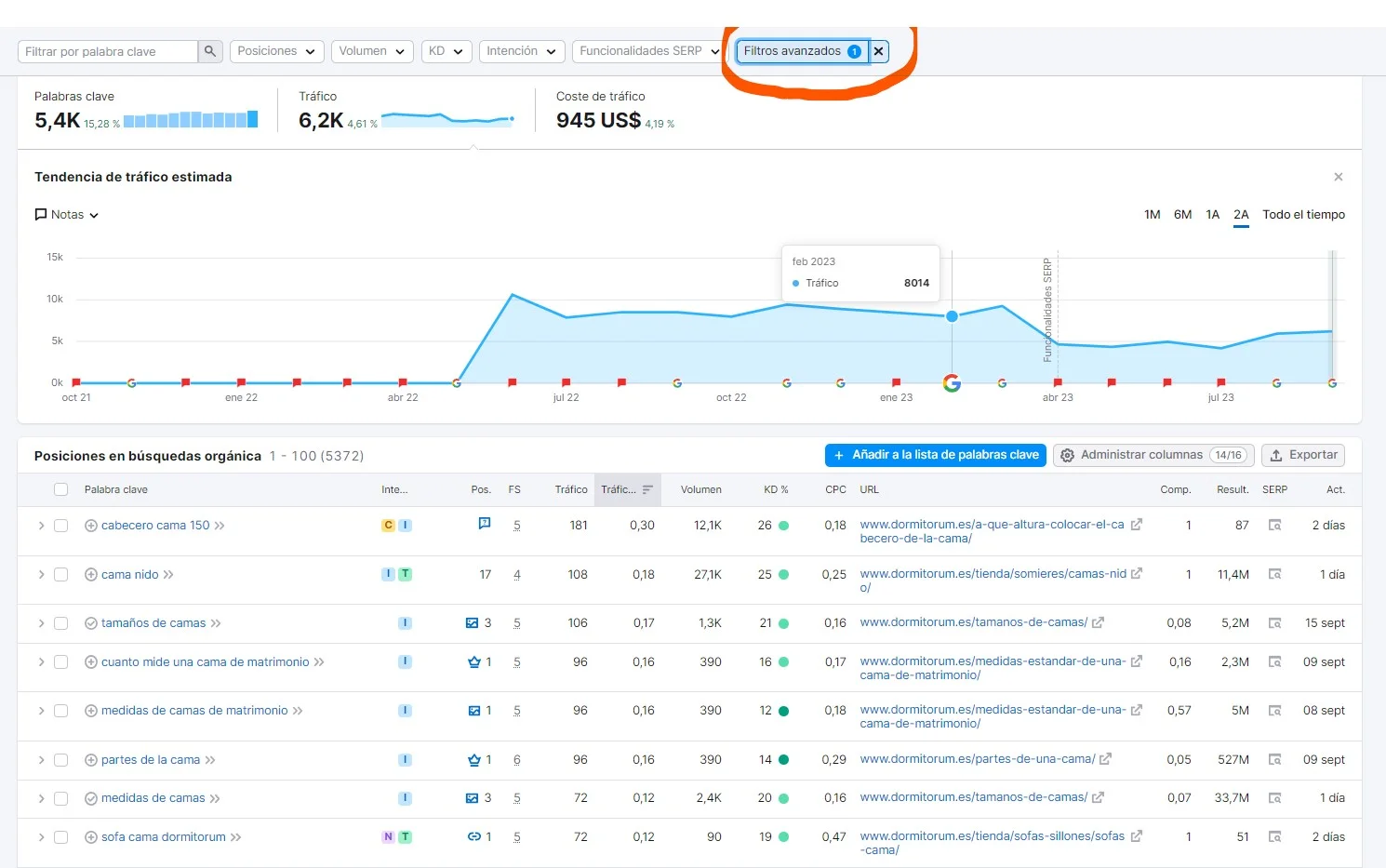
In order to eliminate seasonality as a growth factor, we must make a comparison with the previous year.
5. Branded vs. unbranded traffic
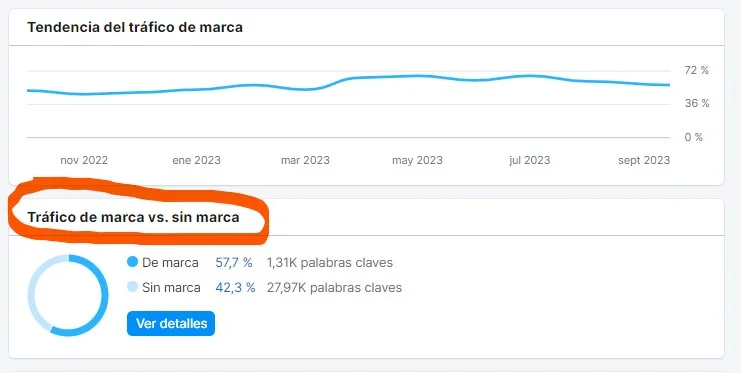
An important metric is to look at the investment of branded traffic in favour of non-branded traffic. At the agency, we have clients who have a lot of advertising efforts and have brands with a lot of brand recognition. Therefore, in many cases, 80% of their traffic comes from branded searches. The mission of a SEO strategy is to grow organic traffic, or traffic that comes from searches where the brand is not present. For example:
Brand search: Nike Basketball Shoes
Unbranded search: Basketball shoes
Obviously we are interested in attracting organic traffic as they are customers who do not know our company and also, adding up the searches of that market, they are always much more voluminous than those of the brand. You can calculate this with Semrush:
6. Keyword positioning
The monitoring of critical keywords is extremely important to know if we are positioning correctly those keywords that represent products or services.
Previously one of the main KPIs for evaluating strategy, one URL can now rank for tens or even hundreds of keywords. Nevertheless, it is still a good indicator that important keywords rank preferentially.
At the seo agency we use the Semrush position tracking tool:


7. Link or backlink profile
As I am writing this article from the Marketzilla's team of SEO experts, In this respect, it can be certified that the link profile is still one of the main ranking factors in search engines such as Google.
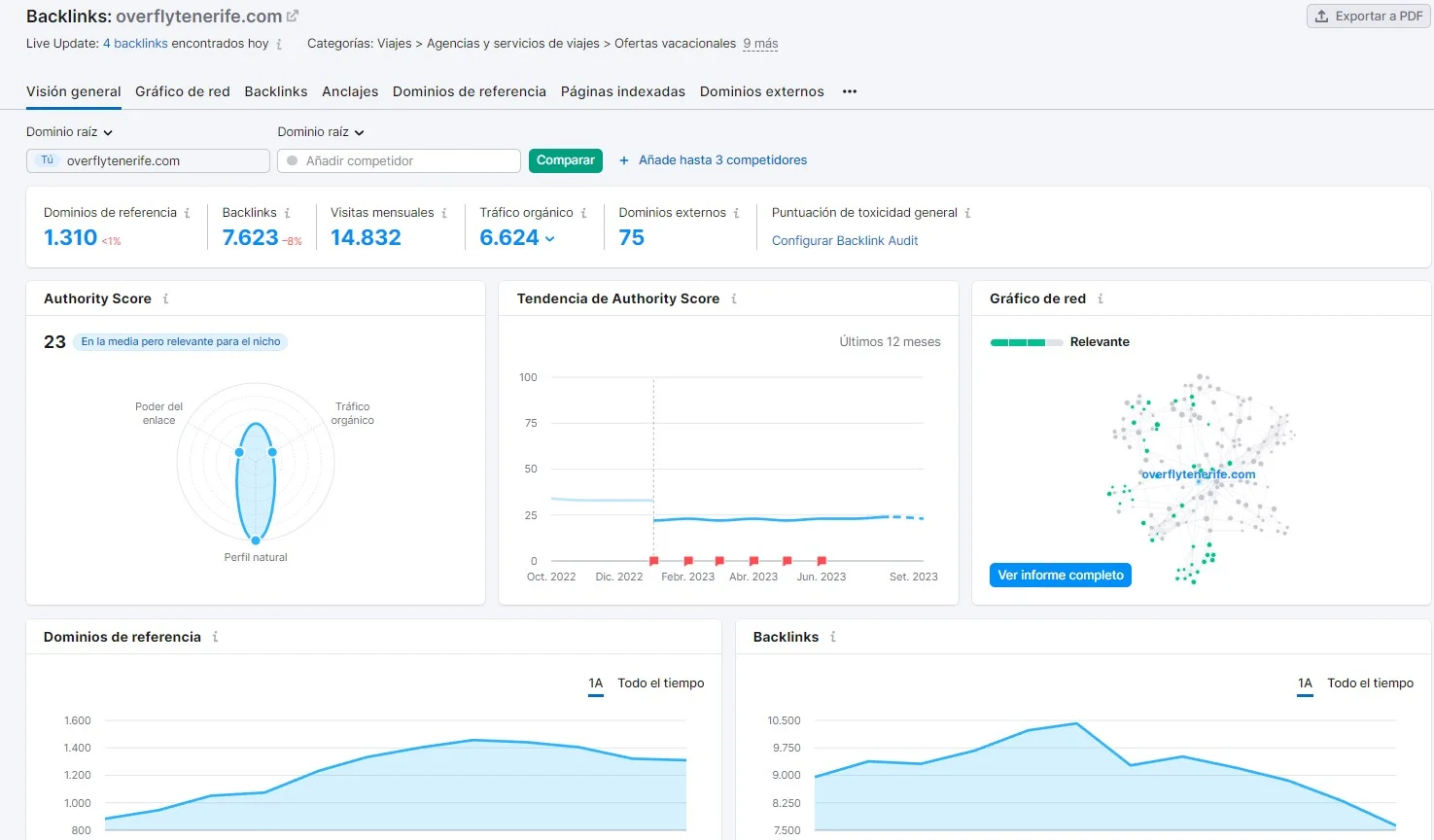
Therefore, in order to find out what state or point your website is in with regard to this issue, you should analyse on the one hand how many links you currently have, from how many domains, how many of them are between 30 and 100 domain authority and if, within this profile, you have toxic links that should be sent to Disavow from Google Search Console.
It is also important to review the missing links to try to recover them and to see where the gained links come from. At Marketzilla SEO Agency we use the Analysis of backlinks and the Audit Semrush backlink analysis to simplify this task:
8. Organic CTR calculation
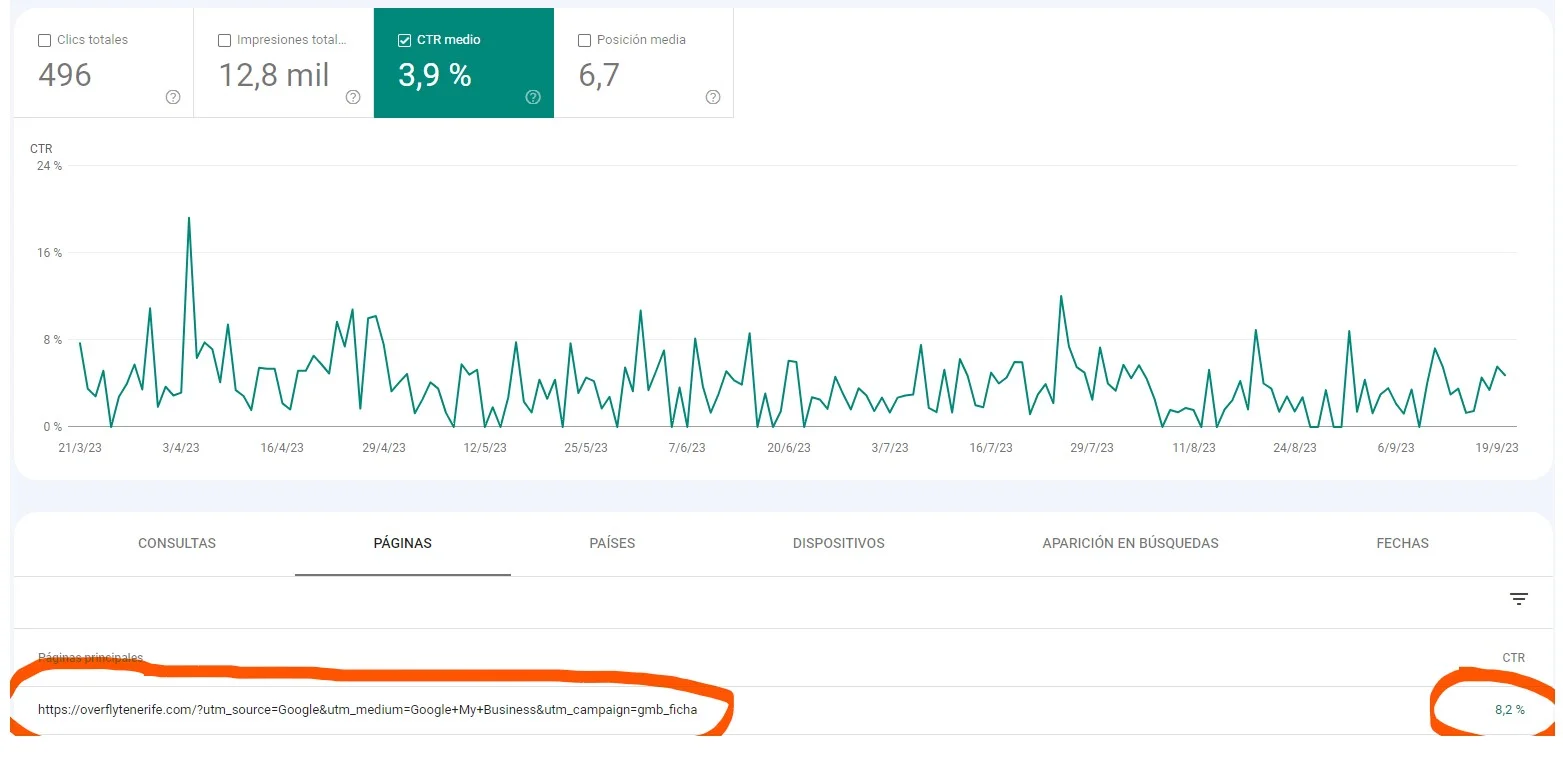
This metric is very important and represents the percentage of potential customers who click on search results linked to your website. This percentage is directly related to impressions. It is calculated by dividing the number of impressions by the number of clicks. The final result determines the CTR percentage.
Now you may be wondering, how can we positively influence this metric to convert better, that's a good question. The answer is by modifying the title (which has SEO power) and the meta description (which has more impact on CTR).
Using Google Search Console, we can analyse the average CTR of our queries or keywords and the urls involved as shown in the following graph:

9. Bounce rate
If your bounce rate is too high, it means that you are not managing to retain your potential customers and therefore your traffic sources are losing strength.
The bounce rate indicates the exit of a user once they have accessed your website without taking any action. This could be clicking on a link, filling out a contact form or making a purchase. Logically, if the rate is high, it would indicate that the content is not relevant or is not well aligned to the users who visit it. Therefore, working on developing quality content is essential.
This KPI is used by Google to evaluate the quality of a website. If the rate is high, it could conclude that the quality of the content is low or irrelevant to the target audience and affect keyword rankings.
The bounce rate is calculated by dividing the number of visits that did not take any action by the total number of visits in a given period. For example, if a website receives 100 visits and 80 of them leave the page without taking any action, the bounce rate would be 80%. Note that this calculation is based on G4, as Google Analytics Universal was calculated slightly differently.
You can find out the bounce rate of your urls in Google Analytics 4 at Behaviour > Site content > All pages. Please note that you will have to configure this SEO KPI in G4 to be able to see it. Here is a video so you can follow it.
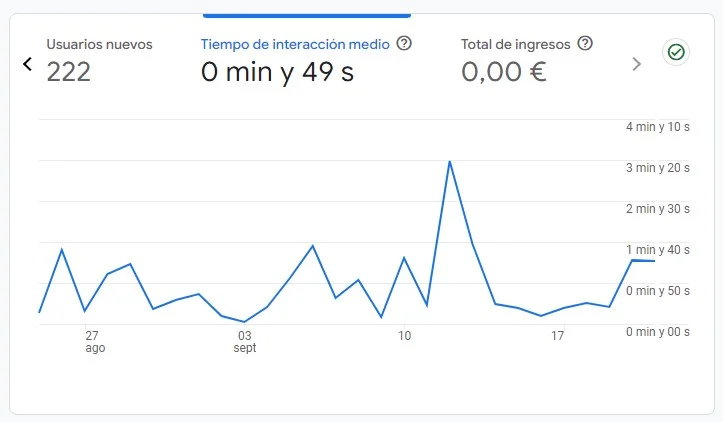
10. Average time on page or average session time
The longer a potential customer stays on the page, the more likely they are to interact. Therefore, there is a greater chance of conversion. It is therefore very important to increase the average time that users spend on your page as a key to performance. If we observe short user times, we will have to study ways to increase them.
You can see these times in Google Analytics 4 in the behavioural area.
11. Indexation and coverage problems
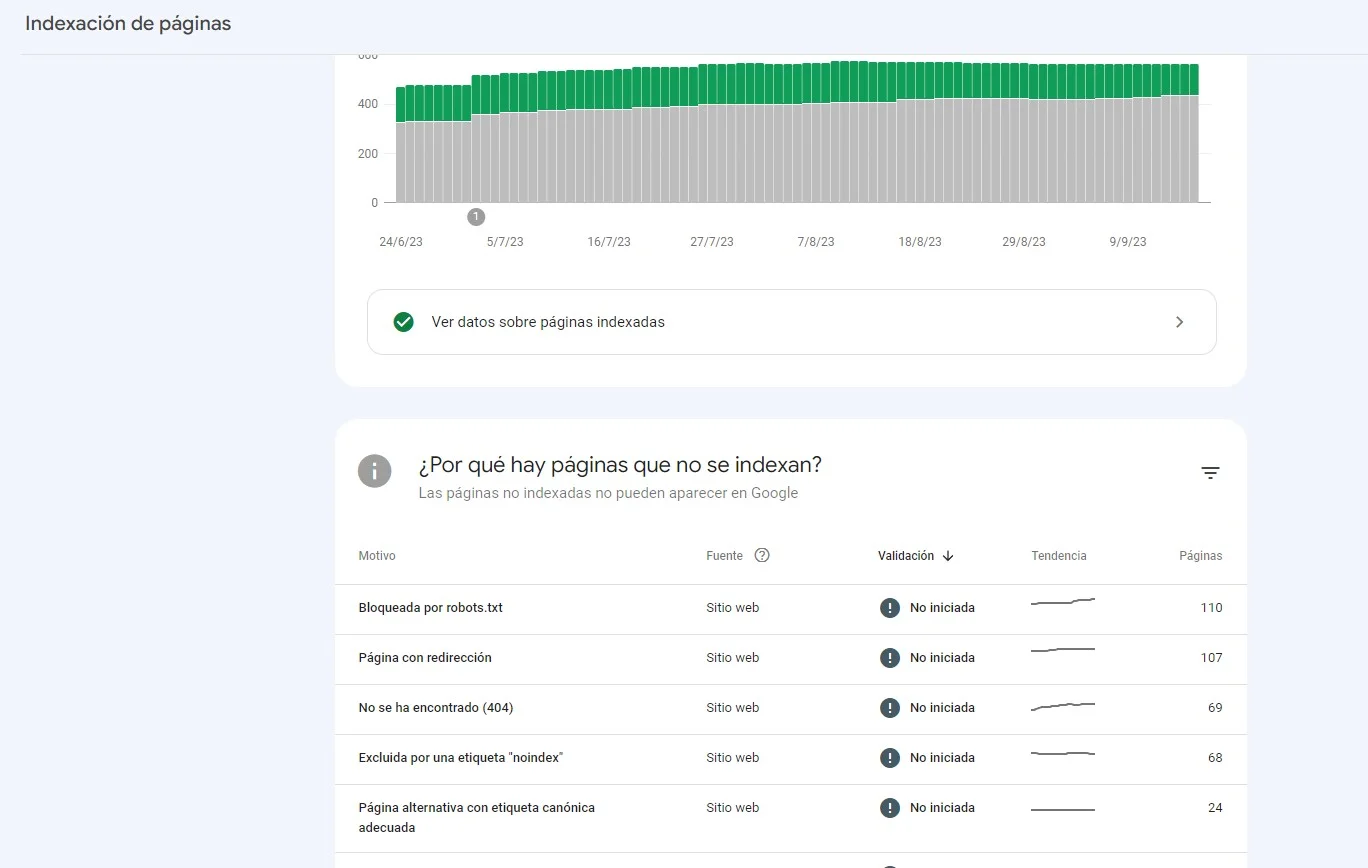
The “crawl errors” found through Google Search Console represent so-called coverage problems that can affect your website's ranking.
Typically these errors are:
- Errors 5xx
- Errors 4xx
- Various tracking problems
- Urls noindex
- Pages crawled, but not indexed
- Pages discovered, but not indexed
- Duplicate pages, these are URLs submitted but not selected as canonical.
- URLs blocked by robots.txt file
Monitoring and resolving these issues can be taken as a KPI as they can affect the success of your SEO strategy.
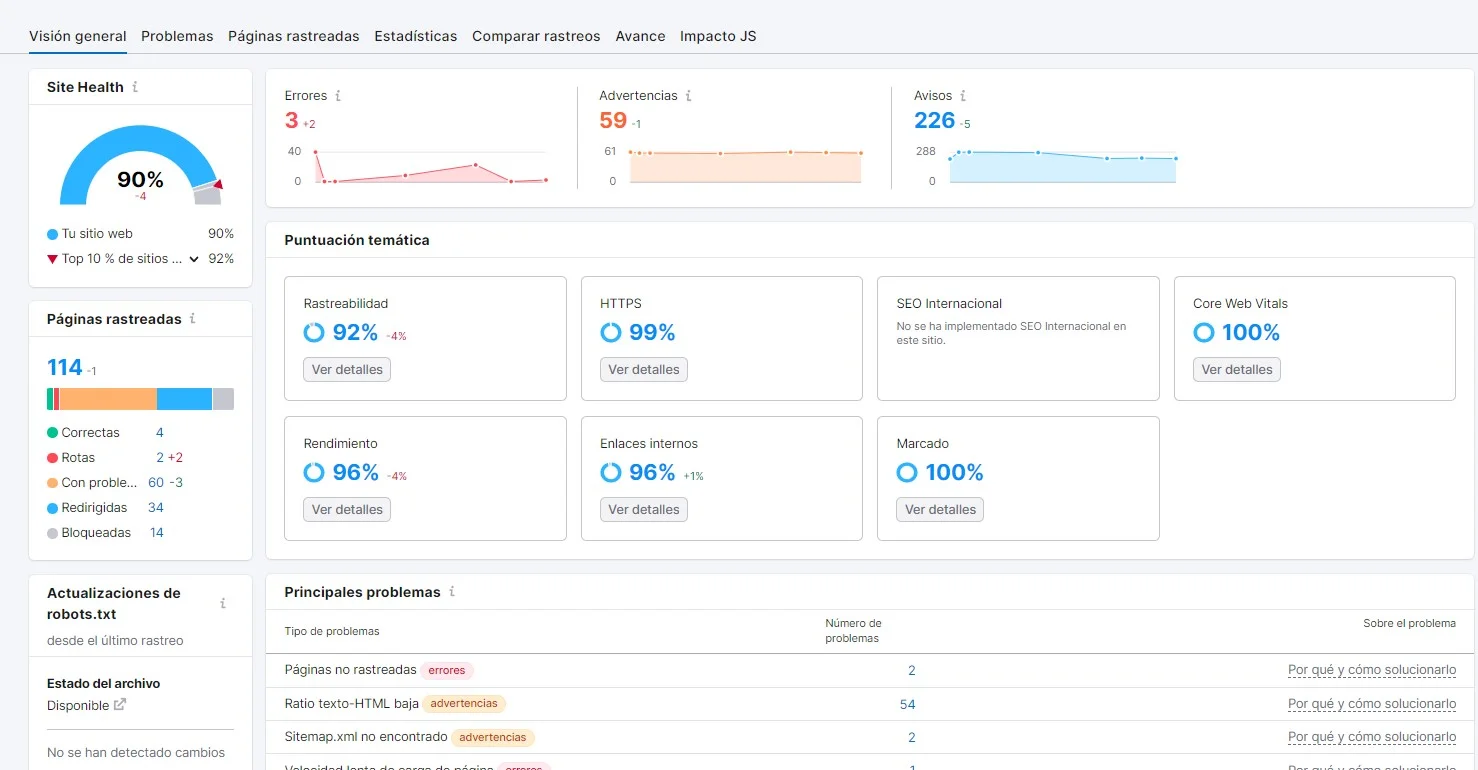
12. Web loading speed and performance
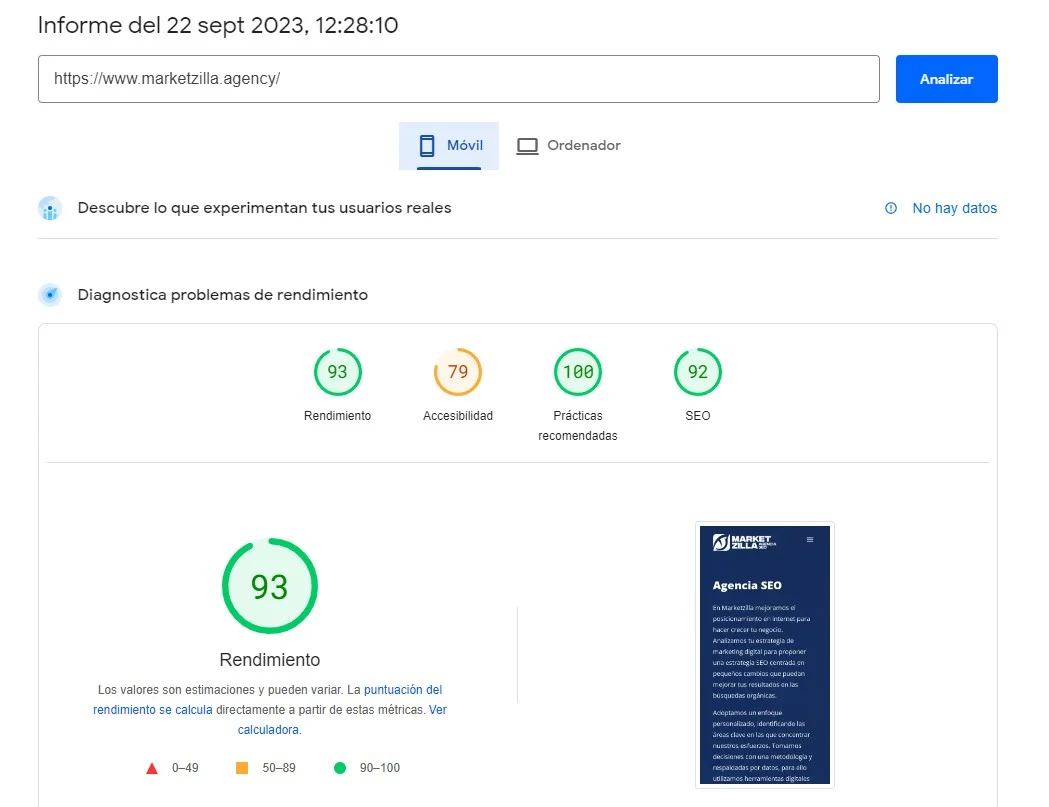
The loading speed of your website, especially on mobile devices, can directly impact your rankings. In addition, if your web speed is poor, it will increase your bounce rate and therefore directly affect your performance. The best measurement tool for this is Google's own PageSpeed. However, even if you currently have good results, keep in mind that the measurement changes over time.
This may be because the photos have not been optimised correctly when uploading new content and may be slowing down the website.
You may need to renew the server and increase the Ram memory. Therefore, the review of the loading speed should be a constant subject. Using the Semrush Site Audit tool you can regularly run this work in an automated way.
Below is a screenshot of a PageSpeed measurement:
These 12 SEO KPIs that we propose are the most important to know if you are on the right track. They will also tell you if you are achieving the goals you have set and if this is having the expected effect on the reality of the company in terms of sales or leads.
SEO Blog

Generative AI revolutionises SERPs in Spain
26 March 2025 marked a turning point in the Spanish digital landscape. Google officially launched in our country the long-awaited "AI-powered Views", a revolutionary feature aimed at completely transforming the way users interact with search results.

Ultimate Guide to SEO for Lawyers
In the competitive legal market, standing out online is crucial to capture the attention of potential clients and differentiate yourself from other law firms. SEO for lawyers plays a key role in ensuring that your law firm is visible on Google and other search engines. A good strategy not only increases your web traffic, but also improves the conversion of visitors into actual clients.

What is Search Marketing and why is it key to your digital strategy?
Nowadays, appearing in the top search results has become a priority for most online businesses. Search marketing is positioned as one of the most effective tools to achieve this goal, as it combines organic positioning efforts and paid advertising. This article delves into the meaning of search marketing, covers the main concepts of SEO and SEM, and shows how to make the most of them to stand out on the Internet.

Conditions for a Perfect SEO Title on Google
The SEO title is one of the most important elements for Google ranking. Not only does it influence the ranking of your page, but it also has a direct impact on the Click Through Rate (CTR). That is, the number of users who click on your result when it appears in the SERPs.

How to rank in Google's artificial intelligence overviews
Google's artificial intelligence overviews, also known as Google's AI Overviews, are redefining the way businesses and content creators rank in search results. By integrating generative AI models into SERPs, Google is providing more complete and personalised answers directly in its results.

SEO on page: the definitive guide to optimising your website
On page SEO is one of the fundamental SEO tactics to improve your website's visibility in search engines. When you focus on optimising every page of your site, you make it easier for Google to better understand your content and rank it in relevant results. On page SEO actions ensure that every element on your page matches the user's search intent. In this way, you improve both user experience and ranking factors.

SEO cannibalisation: what is it, how to detect it and how to solve it?
SEO cannibalisation is one of the most common and least understood problems in SEO strategies. This phenomenon can seriously affect your site's performance if not identified and corrected in time. But what exactly is SEO cannibalisation and how can it impact your SEO efforts?

Google or type in a URL?
When we open a browser, we are presented with a bar that gives us two main options: "Google search" or "type in a URL". Although it may seem simple, many people have doubts about which is the best way to make a query or access a website. This article explores these options in depth, explaining their differences, uses and how to make the most of them for a more efficient browsing experience.

Tourism marketing in the digital and offline era
Tourism marketing is an essential tool for connecting hotels and establishments with travellers from all over the world. With the combination of digital and traditional marketing strategies, it is possible to maximise the visibility of tourism offers, attract new customers and retain existing ones. The secret lies in adapting to new technologies and using the tools they provide to increase reach. SEO positioning, e-mail marketing, an optimised commercial website and the use of positive reviews to convince potential customers. Video marketing is also essential for the hotel sector as it faithfully conveys sensations such as comfort, luxury, convenience, climatic conditions or fun.

What is SEO: Complete guide to being number 1 by 2025
SEO (Search Engine Optimisation) is a discipline developed by SEO specialists to get your digital or physical business to number 1 on the most important search engine, Google. Since its beginnings in the 1990s, when the first search engines such as Altavista and Yahoo started ranking websites, SEO has undergone major changes in the way it is applied. However, the goal is the same, to rank on the first page for the most important keywords of your business.

SEO for Hotels in 2025: A Complete Guide to Positioning Your Hotel Online
Tourism in the Canary Islands and worldwide is constantly evolving, and SEO for hotels has become an essential tool to stand out in an increasingly competitive market. If you manage a hotel or are in the hospitality industry, you need an optimised and up-to-date SEO strategy to attract more guests and improve your online visibility.

Is ChatGPT a real alternative to Google?
In a world where Google has dominated the search landscape for decades, new technologies are beginning to challenge its supremacy. The recent combination of ChatGPT and advanced artificial intelligence models has given rise to a phenomenon known as SearchQuake. Could ChatGPT become a viable alternative to Google? So far, Google has dominated the search engine market with 89.98% market share, compared to Bing with 3.94% and YANDEX with 2.4%. They didn't even have to look in the rear-view mirror to see if anyone was coming up to overtake them.

301 Redirect: A complete guide on how it works
The 301 redirect is actually a very simple SEO topic although it sounds technical. Basically when we set up 301 redirects we tell the search engine that when the user calls URL A it will display URL B instead, it's as simple as that. A 301 redirect is an HTTP status code that indicates a permanent redirect from one URL to another. In simple terms, it is a tool that informs web browsers and search engines that a page has been moved permanently to a new address.

8 Advanced strategies for finding perfect SEO keywords
Keyword analysis and keyword selection are fundamental elements of a successful SEO strategy. In this article I will delve into advanced tactics you can employ to identify keyword opportunities and maximise your search engine presence.

Top CTR statistics on Google
The Click Through Rate (CTR click through rate) is one of the most important indicators to measure the success of your SEO strategies. Recent statistics give us a detailed insight into how users interact with search results.

Branding as an SEO strategy in 2025
Branding should be a fundamental part of your SEO 2025 strategy. Google will next year prioritise the ranking of sites that are perceived as authentic brands, leaving behind those that are only optimised for generic SEO. In this way it aims to reward user experience, and identify and exclude low-quality content.

15 SEO Trends for 2025 and How to Prepare for them
SEO is evolving rapidly and predictions for 2025 suggest that current search engine optimisation trends will be transformed by artificial intelligence (AI).

What Domain Authority is and how to improve it
Domain Authority is an essential concept in SEO and digital marketing. Throughout this article, we explore in depth what it means, how it is measured and what strategies we can implement to improve it.

Search intent What is it and how does it affect SEO?
Do you know what user search intent is? Learn how to create content that responds to the needs of your users and optimise your positioning on Google with this small guide from Marketzilla SEO agency.

The Future of SEO in the Age of ChatGPT
Search Engine Optimisation (SEO) has been a cornerstone of digital marketing for decades. Businesses and content creators rely on SEO to ensure that their websites rank high in search results. In this way, content is easily found by users.

Tourism SEO: attracting customers before they arrive
Tourism SEO is an ideal strategy for businesses in Tenerife that want to attract customers just when they are planning their trips. Find out how to increase your online visibility, improve your positioning and get more advance bookings by taking advantage of the digital trends that dominate today's tourism market.

Why is "Semrush for free" the first step to SEO success?
Let's start at the beginning. When I decided to dive into the exciting world of digital marketing, I found myself in a maze of tools, terms and strategies. Among those names, one stood out: Semrush. But what is Semrush? At its core, Semrush is a comprehensive digital marketing solution that allows professionals to track and optimise their online campaigns, analyse site traffic and search for keywords with precision.

Top 10 best chrome extensions for SEO
Let's be honest: search engine optimisation (SEO) can be a lot of work. This is especially true if you are part of a small in-house marketing team, or if you work for a busy agency with only a few dedicated SEO experts.While it would be great to stumble upon a magical genie who could grant you the power to finish your SEO tasks with the snap of a finger, that's certainly a pipe dream.But there are some amazing Google Chrome extensions for SEO that can make your work day (and your entire professional life) a whole lot easier.
The 12 most important SEO keys
SEO is one of the most dynamic areas of digital marketing, as Google frequently updates ranking algorithms to make search a better experience for users. That means that every year, SEO analysts and digital marketers have the opportunity to re-evaluate the SEO trends that drive the search engine landscape.